
Quick Answer
Coliving management software handles recurring rent, room and bed reservations, shared amenity bookings, housekeeping workflow, deposit and contract lifecycle, and resident communication for coliving operators. The right platform depends less on which feature list is longest and more on where you actually are: pre-launch, first three months, ramp-up, stabilized, or seasonal. Most software in the category is priced for stable mid-size operators. If you're a first-time operator with one property and your first move-in is still weeks away, the same platform that's a bargain for a 100-room portfolio can quietly bill you €100 to €400 per month for empty rooms. Co-Desk uses pay-as-you-go pricing: no monthly fee, 2.5% on Stripe Connect transactions only when you take a payment. That structure fits the first 6 to 12 months of a coliving business, when occupancy is the variable that matters most. At stable high occupancy across multiple properties, flat-fee platforms can be cheaper. This guide walks through what each situation looks like, what software should be doing at each one, and what you should reasonably be paying.
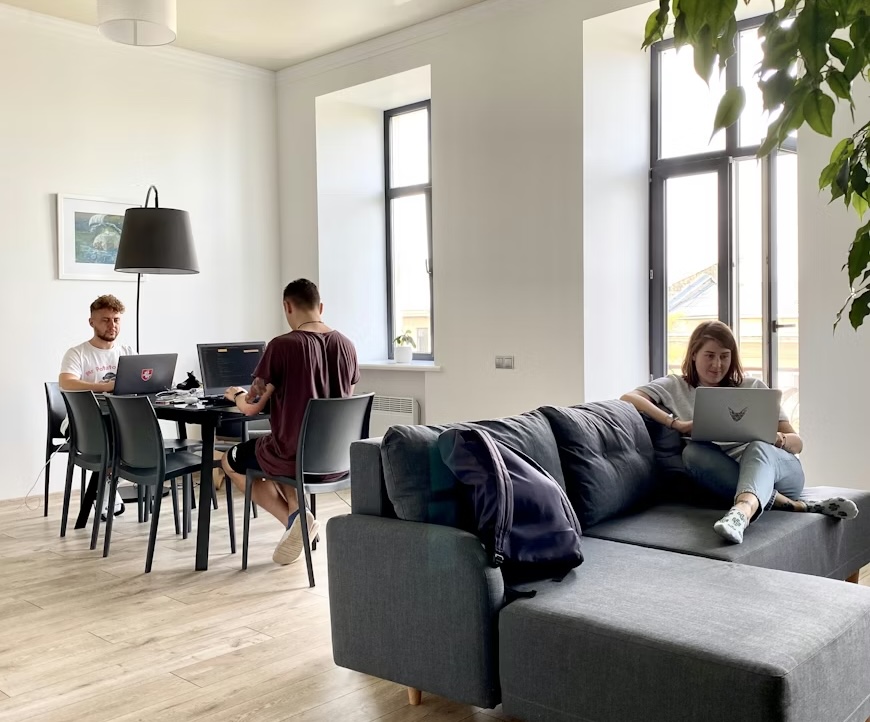
Photo by Elena Rabkina on Unsplash
You signed the lease. The building is gorgeous. The first move-in is six weeks out, and you're trying to decide which software to put on the credit card by Friday. Every guide you've read for the last hour was written for an operator six properties past where you are.
This one starts where you actually are.
I'm a developer building Co-Desk. My co-founder is an ex-Regus area manager with years of operational depth from one of the largest flexible workspace companies in the world, including the long-stay product lines that overlap most closely with coliving. We've been building the platform alongside real operators since the early prototypes, and the coliving side has been shaped by conversations with operators running 8 to 60 beds across Europe.
A note on what this guide does and doesn't do. It walks through what coliving management software should be handling at each stage of your business, in plain language, without padding. It names competitor pricing where the math matters. It includes Co-Desk because I run it, and where Co-Desk is structurally worse than alternatives, I'll say so. Pricing is from public pricing pages or operator-shared quotes as of May 2026. Confirm directly before you commit.
If you're already cross-shopping platforms, the Co-Desk comparison hub is a faster path than this article.
1. Pre-launch: You Haven't Taken a Payment Yet
You have keys, or a signed master lease, or a deal close enough that you've started briefing the painter. You have a landing page or you're a week away from building one. You don't have residents yet, and your first three enquiries are people who heard about you from a friend.
Your day looks like this. You're chasing the painter. You're writing house rules. You're answering one prospective resident on WhatsApp with a long voice note about the neighborhood. You're not running operations because there's nothing to operate yet.
What software should be doing for you right now is small and specific. Holding a deposit cleanly when an early commitment comes in. Showing a calendar of availability for the rooms you're listing. Making your first three enquiries feel professional instead of a chaotic email chain. That's it.
What software should not be costing you right now is anything. A pre-launch operator with zero revenue has no business paying €100 per month for a tool to manage residents who don't exist yet.
This is where Co-Desk's pay-as-you-go pricing is at its most natural. Sign up, configure the property, list rooms, send the first booking link, hold the first deposit. You pay nothing until that deposit converts into rent collected. Your software is pre-launch with you.
2. The First Three Months: 1 to 10 Residents
Three residents in. Two more arriving next week. You're cleaning rooms yourself between guests. You're writing the lease in a Google Doc and adapting it on the fly. Someone's water heater stopped working at 11pm on Tuesday and you spent an hour on the phone with the landlord's maintenance contact.
Your day is operational chaos handled mostly by you. The software role is small but critical: keep the basic operations legible. Who paid what last month, who's checking in this Friday, what room is clean, what room needs a deep clean, where is the signed contract for the resident in room 4.
The mistake first-time operators make at this stage is buying enterprise software because they think they'll need it eventually. You won't, at this stage, use 90% of what an enterprise platform offers. You'll pay for it anyway, including for residents who exist only on paper because the platform bills you by room count or per user license regardless of occupancy.
What you actually need is a short list: recurring rent that runs itself, a way to issue deposits and refunds with an audit trail, a basic housekeeping status someone can update from a phone, and a member portal where residents can see what they owe without emailing you. Six things across the whole category, and most platforms cover the same six. The difference is the pricing model.
Co-Desk at this stage costs 2.5% of whatever rent you've collected. On three residents paying €600 each, that's €45 per month. That's the entire software bill.
3. Ramp-up: Months 3 to 12
You're at 60% occupancy. You can see what 90% looks like from here. Two leases are about to overlap because someone's extending while someone else moves in three days later. You've started standardizing things, mostly because you've gotten tired of explaining the same rules to every new resident.
Your day is busier but more predictable. Software is finally earning its place. Prorata billing on the move-ins runs itself. Deposit holds track properly. The housekeeping list resets cleanly between residents. The member portal handles enough of the "where's my invoice" questions to free up your inbox.
This is where most coliving software pricing models start to bite, and it's worth being specific.
ColivHQ, one of the most affordable dedicated coliving platforms on the market, charges $5 per unit per month with a 20-unit minimum. If you're running a 12-room property at 60% occupancy, you have 7 paying residents and you're billed for 20 units regardless. That's $100 per month for empty rooms. At 30 rooms at the same occupancy, it's $150 for 18 paying residents in a building configured for 30. TheHouseMonk's Starter plan is $150 per month for up to 150 units, which is structurally similar math: you pay the floor whether the building is full or half empty.
A note on coworking platforms (Nexudus, Cobot, Spacebring, Archie). Their starting tiers look cheap ($70 to $165 per month) and some of them now market to coliving operators. Avoid them for coliving unless your operation is essentially coworking with a few rooms attached. Most don't have native room and bed inventory, housekeeping status workflow, or deposit lifecycle. Configurable resource types are not the same as native coliving support. The friction shows up in month three.
Co-Desk's 2.5% on 7 paying residents at €500 each is €87 per month. On 18 paying residents at €500 each it's €225. Both numbers track the operator's actual cash, not the operator's optimistic occupancy plan.
4. Stabilized: One to Three Properties at 80% or Higher
You're running consistent high occupancy. Move-ins and move-outs roughly balance each month. Most new residents come from referrals. Your operations are routine enough that you don't think about them most days.
Now the math changes, and this is where I have to be honest about Co-Desk.
A 30-room property at 90% occupancy and €500 per room is processing €13,500 per month. Co-Desk's fee on that is roughly €338 per month. ColivHQ on the same property is $150 per month (30 rooms × $5). TheHouseMonk's Starter tier is also $150 per month. Quote-based platforms (Res:harmonics, Lavanda) will land somewhere higher, but at stable occupancy their flat fee likely still beats Co-Desk on absolute monthly cost.
At this stage, Co-Desk is more expensive than the alternatives on raw monthly cost. That's not a marketing position. That's the math.
Whether that matters depends on what you value. A platform whose cost scales with revenue charges more when you're earning more, and it also charges nothing during the seasons when you're not. A flat-fee platform smooths your bill but charges you the same in November as in August. Stable operators with consistent year-round occupancy are often genuinely better off on flat fees. Operators with even mild seasonality, which is most of the coliving market, are often better off on revenue-aligned pricing even at high occupancy, because the off-months reset the math.
If you're stably full year-round and intend to stay that way, a flat-fee platform is rational. If your business has any rhythm to it, run the math both ways before deciding.
5. Seasonal: Surf, Mountain, or Nomad Coliving
Surf coliving on the Atlantic coast. Mountain coliving in the Alps. Nomad coliving in Bali or Lisbon. Your March is not your November. Your business is built around that fact. Rates, marketing, hiring, everything shifts with the season.
Your software bill is the one line item on your P&L that shouldn't shift but currently does, against you. A 25-unit property paying $5 per unit per month is $125 in August when you're at 95% capacity, and the same $125 in February when you're at 30%. A flat-fee coworking platform repurposed for coliving is the same in both months. You're paying full software cost in the months you're actively losing money.
The fix isn't a different vendor with the same pricing structure. It's a structurally different pricing model. Pay-as-you-go aligns software cost with the season your business is actually having. August is the month you pay the most because August is the month you're earning the most. February is the month you pay almost nothing because February is February.
This isn't a generic argument. The math is simple enough to run yourself: take your average monthly GMV across the year, multiply by 2.5%, and compare against any flat fee a competitor quotes for 12 months. If your peak-to-trough occupancy ratio is more than 2:1, pay-as-you-go pricing is structurally cheaper across the year than any flat fee at any reasonable equivalence point. See current pricing at co-desk.eu/pricing.
What Software Should Do, Across Every Stage
Across every situation above, the operational floor is the same. Coliving software should natively handle:
- Recurring monthly rent, with automatic retries on failed cards and clean reactivation when residents update them.
- Mid-month move-ins with prorata computed automatically on the first invoice.
- Shared amenity bookings (parking, laundry slots, kitchen blocks, meeting rooms) that residents can reserve and pay for themselves.
- Housekeeping status tracking that updates from a phone, with rooms moving from dirty to clean to ready between residents.
- Deposit and contract lifecycle including holds, partial refunds with line items, and a clean audit trail.
- Resident communication built in, not bolted on through a third tool that doesn't know who your residents are.
If any of these require a manual workaround on the platform you're evaluating, the friction will show up by month three. Make any vendor demonstrate all six before signing. The Co-Desk coliving solutions page walks through each in product context.
What You Pay
For an 8-room single property at €500 per room per month, here's what each dedicated coliving platform actually costs at different occupancy levels, as of May 2026.
| Platform | 40% occupancy | 70% occupancy | 90% occupancy |
|---|---|---|---|
| Co-Desk | €40 | €70 | €90 |
| ColivHQ | $100 (20-unit minimum) | $100 (20-unit minimum) | $100 (20-unit minimum) |
| TheHouseMonk / MonkSpaces | $150 (Starter tier, up to 150 units) | $150 (Starter tier) | $150 (Starter tier) |
| Res:harmonics | Quote on inquiry | Quote on inquiry | Quote on inquiry |
| Lavanda | Quote on inquiry (enterprise) | Quote on inquiry (enterprise) | Quote on inquiry (enterprise) |
| Mangobeds | Quote on inquiry | Quote on inquiry | Quote on inquiry |
For a 30-room property at the same €500 per room, at stable 90% occupancy: Co-Desk is roughly €338 per month, ColivHQ is $150 (30 units × $5), TheHouseMonk is still $150 (well within the Starter tier's 150-unit cap). Co-Desk costs more at this scale. That's the tradeoff: pay-as-you-go aligns with revenue both directions. Lower in slow months, higher in busy ones.
The realistic invoice is often higher than the headline on every platform. Resident apps, API access, additional properties, visitor management, channel manager add-ons, and premium support are typically paid modules. Quote-based platforms (Res:harmonics, Lavanda, Mangobeds) tend to land in the €300 to €1,000+ per month range for a small operator once everything is included, but the real number only surfaces after a discovery call. Ask in writing what's included before committing.
Frequently Asked Questions
What is coliving management software? Coliving management software is a platform that handles recurring rent, room and bed reservations, shared amenity bookings, housekeeping workflow, deposit and contract lifecycle, and resident communication for coliving operators. Generic property management systems and hotel PMS tools usually fall short because they were built for different operational models, typically long-term unfurnished rentals or nightly hotel stays.
Is there free coliving management software? Co-Desk is pay-as-you-go: no monthly fee, no setup fee, no support fee. Operators sign up and use it without paying anything until they take their first payment from a resident, at which point Co-Desk earns 2.5% on each Stripe Connect transaction on top of Stripe's standard processing fees. A custom plan is available for operators who can't or don't want to use Stripe. ColivHQ is free for operators with fewer than 5 units.
Why does pricing matter so much during ramp-up? Most coliving platforms charge per unit, per room, or a flat monthly base fee. None of those scale with occupancy. A 25-room operator at 40% occupancy is billed identically to the same operator at 95% occupancy, even though the second one is earning more than twice as much. During ramp-up, that gap shows up directly in cash flow.
What's the difference between coliving software and hotel PMS? Hotel PMS is built for nightly stays, daily rate management, and OTA distribution. Coliving software is built for recurring monthly rent, longer stays (typically 1 to 12 months), shared amenity bookings, and resident community. Operators who try to run coliving on a hotel PMS usually end up rebuilding rent automation, deposit handling, and community communication by hand.
Do I need separate software if I run both coworking and coliving? Not if the platform supports both natively from a single account. Most coliving-only platforms don't handle coworking memberships, and most coworking platforms either lack a true room and bed model or have added one without housekeeping or deposit workflows. Co-Desk handles both from one account with shared resident and member records.
Can I use Airbnb's tools to manage a coliving space? Airbnb is a marketplace, not a management platform. It doesn't automate recurring rent, handle multi-month contracts, manage deposits with refund logic, or provide community communication. Most coliving operators use Airbnb for short-term unit fill where that makes sense, and a dedicated coliving platform for everything else.
How long does it take to set up coliving software? Co-Desk is live in 30 minutes, including Stripe Connect and floor plan configuration. ColivHQ and TheHouseMonk typically take a few days. Enterprise-flavored coliving platforms (Res:harmonics, Lavanda) are implementation projects running several weeks, often with a paid onboarding package on top of the monthly fee.
Can I switch coliving software later if I pick the wrong one first? Yes, but the cost varies by vendor. Before signing with any platform, confirm in writing that you can export all resident, booking, financial, and document data in standard formats on demand. A vendor that won't promise this is one you'll regret.
Related Reading
- Compare Co-Desk against the major coworking and coliving platforms
- Co-Desk Pricing
- Co-Desk Coliving Solutions
- How to Start a Coworking Space: The Complete Software Stack Guide
- Co-Desk Integrations (Stripe, Kisi, Brivo)
Still scoping coliving software?
Co-Desk is pay-as-you-go management software for coworking and coliving operators. Rooms, reservations, recurring rent, shared amenity bookings, housekeeping, deposits, and resident communication, all in one platform. Live in 30 minutes. No subscription, no setup fee, no support fee. 2.5% on Stripe Connect transactions, only when you take a payment. Get started: pay only when you get paid →
This guide reflects my own experience building Co-Desk, my co-founder's operational background, and conversations with first-time coliving operators across Europe. Pricing references are from public pricing pages or operator-shared quotes as of May 2026. Products and prices evolve, so your experience may vary. If a vendor has shipped significant updates since publication, get in touch and I'll revisit.